
The harbour minesweeper · El Mina
El Mina Ten minutes out, and thirty metres down
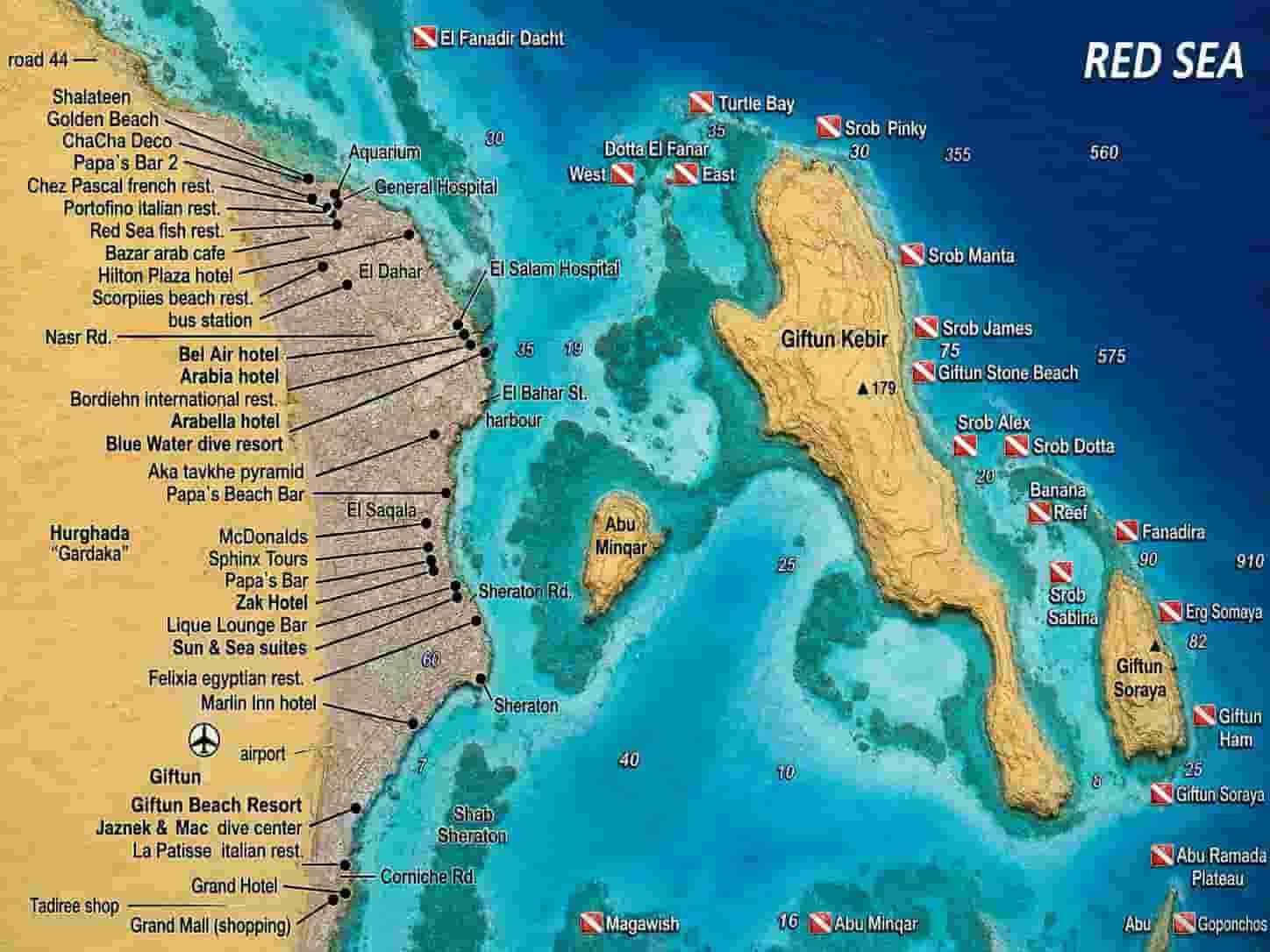
27°13.92′ N · 33°51.57′ E · 17–30 m · 10 min
An Egyptian minesweeper, sunk by Israeli aircraft in 1970 and lying on her port side just outside Hurghada harbour. El Mina is the shortest boat ride on this coast and one of the least forgiving dives on it: deep, often dark, frequently swept by current, and still carrying live ammunition across her decks.
El Mina, and how she was lost
Firstly, the facts are short because the record is short. Specifically, she was an Egyptian minesweeper, and in 1970 Israeli fighter aircraft attacked her outside Hurghada harbour. Then a bomb opened her hull and she went down where she was.
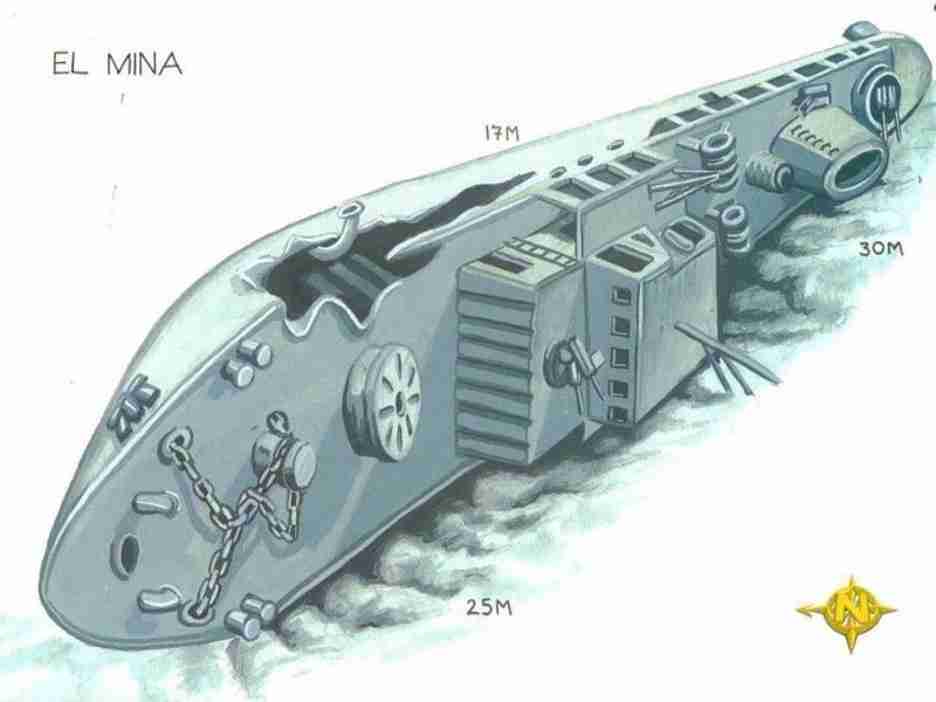
Consequently she now lies on her port side, close enough to the harbour entrance that the boat ride out takes about ten minutes. Specifically, the bow sits at twenty-five metres and the stern at thirty, while the highest point of the wreck reaches up to seventeen.
Notably, the evidence of the attack is still all over her. Above all, the blast hole from the bomb is the obvious feature near the top of the wreck. Meanwhile the hull around it is perforated with machine-gun holes from the aircraft that made the run, which is the kind of detail that reads very differently underwater than it does on a page.
Read about her before you dive her. Certainly this is a wreck where the history does most of the work. Fifty-odd years of coral has softened the shape, and without knowing what happened here you are looking at a broken hull; knowing it, you are looking at the last afternoon of a working ship.
What is still there
- Firstly the blast hole, near the shallowest part of the wreck
- Then the starboard anchor, still in place where it was stowed
- Also bullet holes across the surrounding hull plating
- Meanwhile the rudder and propeller sit intact at the stern
- Besides those, winches and cable rolls across the deck, plus the sweeping gear
- Finally the bridge and radio room, visible through portholes and hatches
| Type | Minesweeper, Egyptian |
| Lost | 1970, to Israeli aircraft |
| Position | 27°13.92′ N, 33°51.57′ E |
| Attitude | On her port side |
| Depth | 17 m at the top, 25 m at the bow, 30 m at the stern |
| Travel | About 10 minutes from central Hurghada |
| Level | Experienced; wreck training for any penetration |
Before you get in the water
There is live ammunition on this wreck. Namely, it is spread around the decks and it has been in the sea since 1970. Therefore the rule is simple and has no exceptions: touch nothing, move nothing, pick nothing up. Not to look at it, not to photograph it better, not at all.
Above all, do not let El Mina’s ten-minute boat ride set your expectations. A site this close to the harbour gets treated as a casual afternoon, whereas the numbers say something else entirely. Namely, thirty metres at the stern is a real depth, the current can be ripping, and the visibility is often poor because of where she sits relative to the harbour mouth.
Consequently the gas plan matters more here than the conditions suggest. Specifically, check your contents often rather than occasionally, particularly if you are working against current, and start up with more in hand than you would on a shallow reef.
Conditions to expect
- Firstly current, which can be strong enough to make progress hard work
- Then visibility, often poor for a Red Sea site because of the harbour
- Also depth: 17 m at best, 30 m at the stern, with no shallow escape
- Meanwhile sharp torn metal wherever the hull was opened
- Finally the ammunition, which is the reason nothing gets touched
On penetration
Certainly it is tempting. Notably, the openings are inviting and the interior is close. Yet the edges are sharp, the metal has had five decades to weaken, and there is ordnance inside as well as out.
Frankly the better answer is that you do not need to go in. Namely, the bridge and the radio room can both be examined through the portholes and hatches from outside, which is most of what people enter for. Above all, anyone who does go inside should have wreck training, a torch, a line and a reason.
Diving El Mina from bow to stern
The bow and the blast hole
Firstly, the top of the wreck reaches seventeen metres near the blast hole, which makes this the natural place to start and the natural place to end. Notably, the starboard anchor is still in its place, and the plating around it carries the bullet holes.
Meanwhile the bow area is where the small photography lives. Specifically, red sponges cover the metal in patches, and pyjama slugs turn up on them often enough to be worth looking for deliberately rather than hoping.
The deck and the minesweeping gear
Then, working aft along the deck, you pass winches and cable rolls, and then the equipment that gives her the name. Specifically, the sweeping devices are torpedo-shaped and they sit there looking, to a startling degree, as though somebody could assemble them and put them back to work this afternoon.
Notably, this stretch is also where the bridge and radio room can be examined from outside. Namely, look in through the portholes and the open hatches and you get the interior without any of the risk of being in it.
The stern
Finally the stern, at thirty metres, where the rudder and the propeller sit intact below what used to be the waterline. Meanwhile, because this is the deepest point and usually the furthest from the line, it is the part that costs the most gas and the most bottom time.
Consequently the sensible order is to work aft early, while your numbers are good, and keep the shallow bow work for the way back. Frankly, doing it the other way round is how people end up rushing the ascent.
Marine life on El Mina
Glassfish
Big schools use the openings in El Mina as refuge, which is what fills the wreck with movement.
The hunters
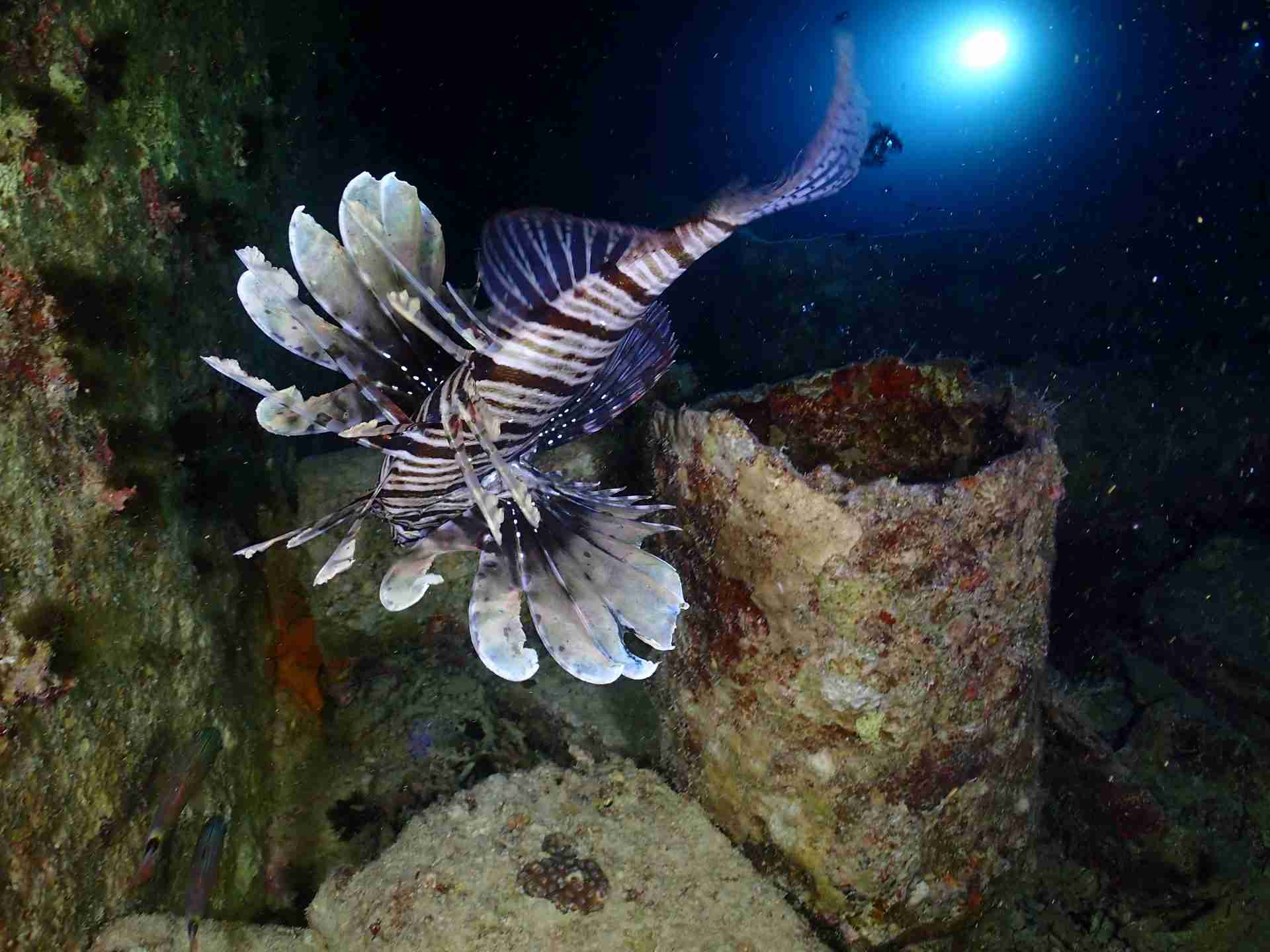
Meanwhile lionfish and jackfish compete over those same schools, working the openings from both directions.
Red sponges
Namely, concentrated around the bow, and genuinely photogenic against the grey plating.
Pyjama slugs
Certainly worth hunting on the sponges near the bow. Small, unmistakable, and the reason to carry something that focuses close.
Planning a dive on El Mina
Practical notes
- Firstly, plan it as a deep dive, because thirty metres is a deep dive
- Then check the current before anyone enters, since it can be severe
- Also work the stern early, and finally save the shallow bow for the way back
- Meanwhile carry a torch, because the light here is rarely generous
- Notably, nitrox earns its keep on a profile that sits this deep for this long
- Consequently start up with more gas in hand than a reef dive would need
- Finally, touch nothing. There is live ammunition on this wreck
The ten minutes are a trap. Frankly, being close to the harbour makes this feel like an easy option, and it is not one. Treat the boat ride as irrelevant to the planning and look only at the depth, the current and the visibility.
Useful links
- Daily diving from Hurghada — how this wreck is actually dived, as a day trip.
- Hurghada east and south dive sites — the local reefs, most of them a great deal gentler than this.
- Hurghada dive sites, north — fourteen reefs from Fanous out to Blind.
- Small Giftun — and Gota Abu Ramada, both easy days by comparison.
- The Thistlegorm — the other war wreck, further north and far larger.
- Safety standards and emergency care — briefings, oxygen and chamber contacts.
- Red Sea Liveaboard — safari routes across the Egyptian Red Sea.
- Divers Alert Network (DAN) — insurance and emergency guidance.
Frequently asked questions
How deep is El Mina?
Specifically, seventeen metres at the highest point, twenty-five under the bow and thirty at the stern. Nothing here is shallow.
What level do I need?
Namely, experience beyond entry level, because of the depth and the current. Wreck training on top of that for any penetration.
Is there really live ammunition aboard?
Certainly, and spread around the wreck. Touch nothing, move nothing, and take nothing, no matter how harmless a piece looks.
Can I go inside?
Frankly, only with wreck training and good reason. The bridge and radio room can both be seen through the portholes without entering at all.
Why is the visibility often poor?
Namely, she sits just outside the harbour entrance, so she gets whatever the harbour puts in the water. Expect less than open reef.
How long is the boat ride?
Generally about ten minutes from central Hurghada, which is the shortest on this coast and the single most misleading thing about the site.
What are you waiting for?
Book your adventure
Tell us which experience you want to enjoy and leave the rest to us. If you have questions, or you are still choosing between routes, our team will talk it through with you before you commit to anything.
Inquiry