
Strait of Tiran · Northern Red Sea
Strait of Tiran Jackson, Woodhouse, Thomas and Gordon reefs
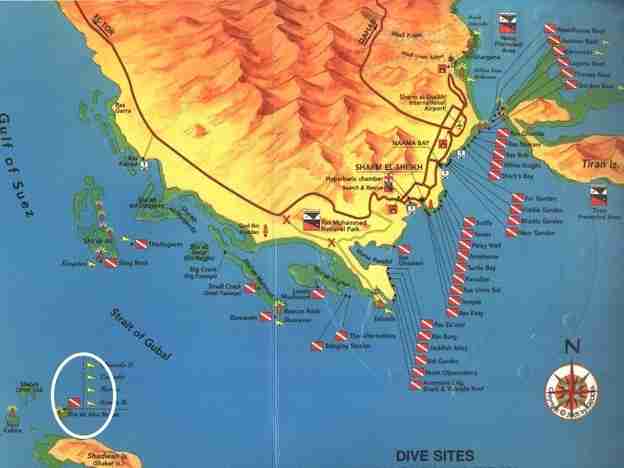
Four coral reefs sit in the middle of the Strait of Tiran, where the Gulf of Aqaba squeezes to its narrowest point. Because the whole gulf drains and fills through this gap, current runs hard, plankton pours in, and predators follow it. That is why the diving here is the best in the northern Red Sea.
How the Strait of Tiran works
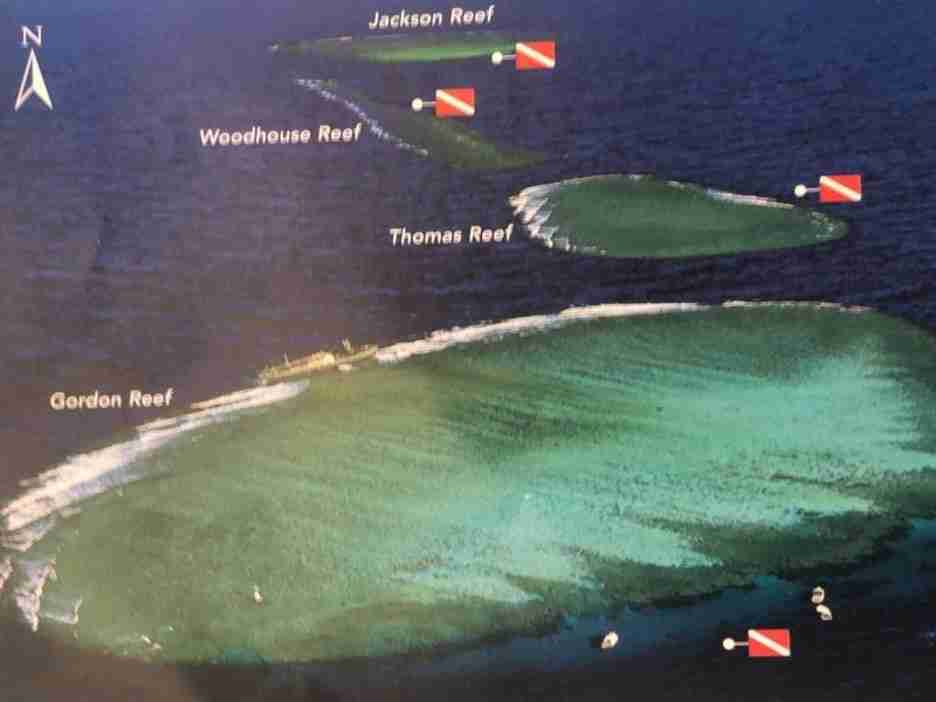
This channel lies at the mouth of the Gulf of Aqaba, bounded to the west by the Sinai coast and to the east by Tiran island. Four reefs run through the middle on a northeast to southwest line, each named after a nineteenth-century English cartographer: Jackson, Woodhouse, Thomas and Gordon.
Those reefs split the channel in two. Grafton Passage, to the east, carries northbound shipping, while Enterprise Passage to the west takes southbound traffic. Further east, beyond Tiran and Sanafir, the seabed makes navigation impossible altogether.
Numbers explain the diving better than adjectives. Here the gulf narrows from ten or twelve miles to just 2.4, while the bottom rises from 1,270 metres to 250 in Enterprise and to a mere 71 metres in Grafton.
What that produces
- First, restricted deep-water exchange, so salinity and temperature rise
- Then faster tidal current squeezed through a shallow sill
- Also bigger wind waves, accelerated by the mountains on both sides
- Wind blows from the north, hardest in the morning, calmer by afternoon
- Consequently the west and north faces stay exposed, the “outside”
- Finally, the east and south faces stay sheltered, the “inside”
Why the fish are here: that current carries plankton and nutrients past the reefs every day. Corals feed, reef fish feed on them, and barracuda, jackfish, tuna and sharks work the edge of the blue.
Jackson Reef, Strait of Tiran
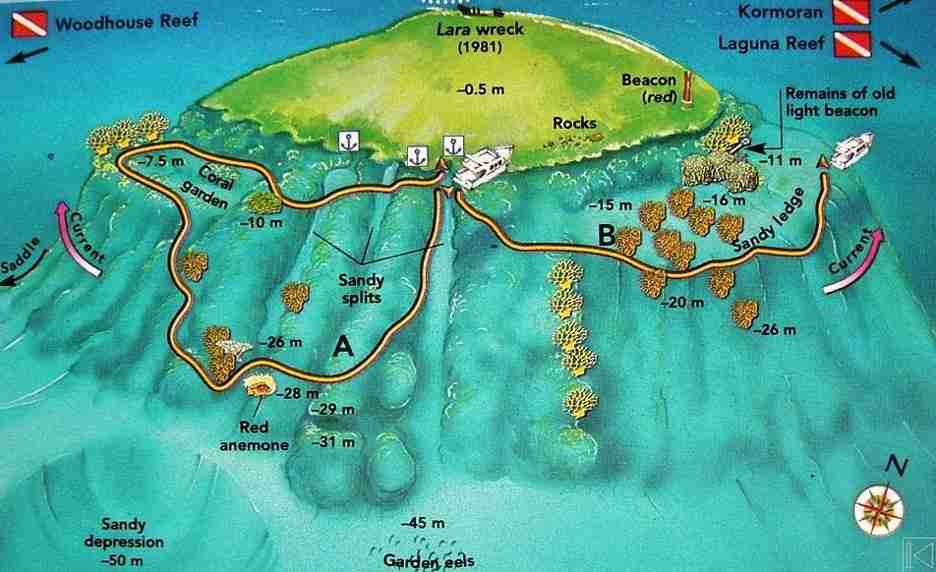
At 28°00.354′ N and 34°28.283′ E, Jackson is the most northerly of the four. Everyone recognises it by the wreck of the Lara, a Cypriot cargo ship of 4,752 tonnes that grounded here in December 1981 and was partly demolished in 1996.
Dives normally start on the southern side, sheltered from wind and swell, where fixed moorings sit close to the reef. Shallow ground is cut with sandy splits before dropping steeply to sand at forty-five metres, home to shy garden eels.
Heading west on dive A you pass gorgonians and a striking red anemone at twenty-eight metres, then a plateau linking to Woodhouse by a saddle. Watch the southwestern corner, though: fire corals cover it and the current there turns violent.
Dive B, the eastern drift
On an ebbing tide the eastern side becomes a drift. About fifteen metres down a sandy ledge runs out and sinks into the blue towards the north.
- Turtles, regularly, along the shallow ground
- Also whitetip reef sharks patrolling the ledge
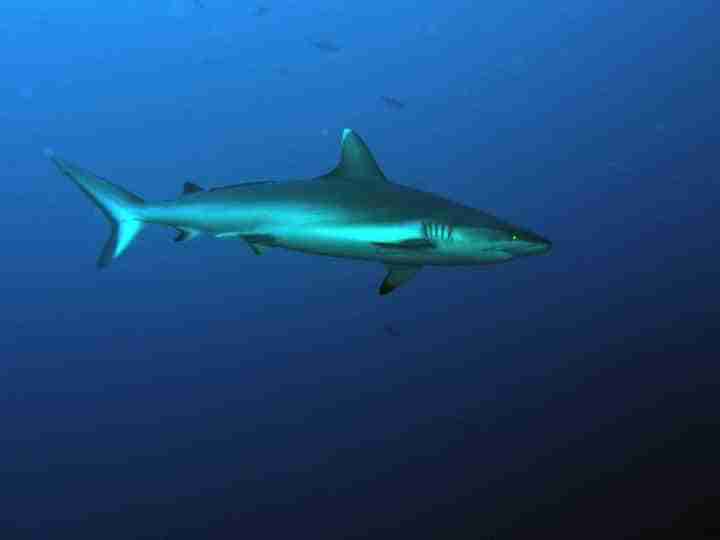
- Grey reef sharks out where the ledge falls away
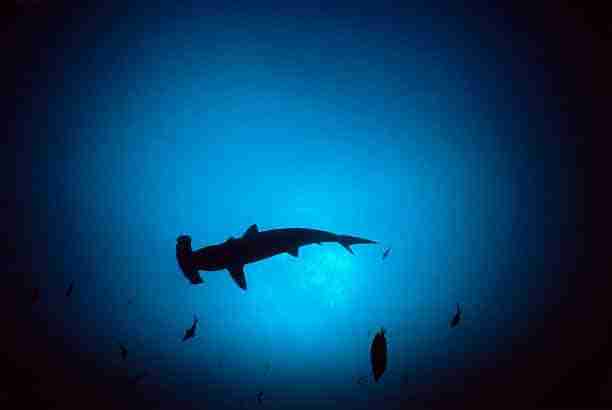
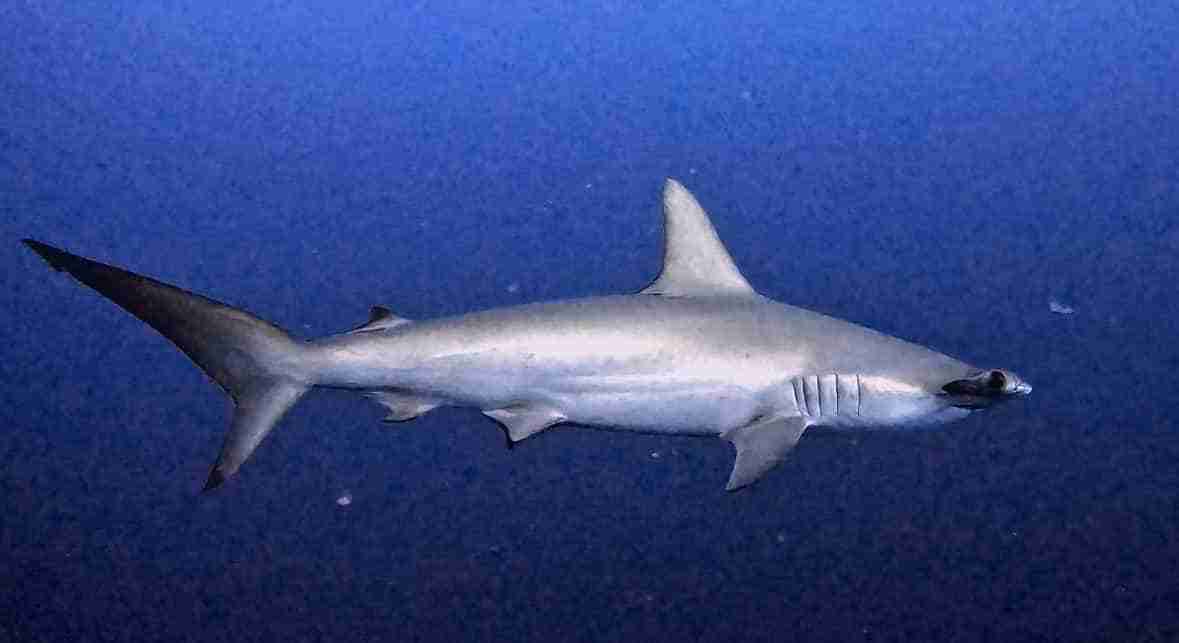
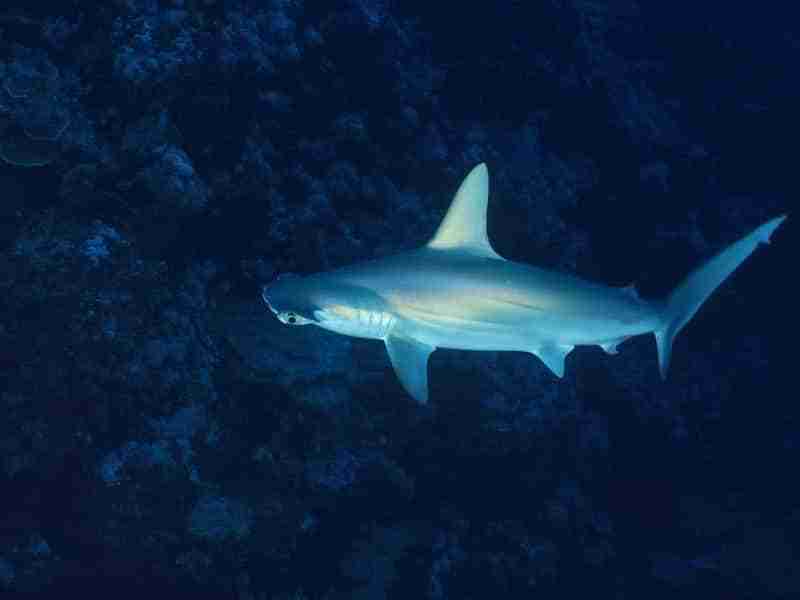
- Then scalloped hammerheads, common from July to September
- Finally the northern side, in the blue off the Lara, at 10–30 m
Woodhouse Reef, Strait of Tiran
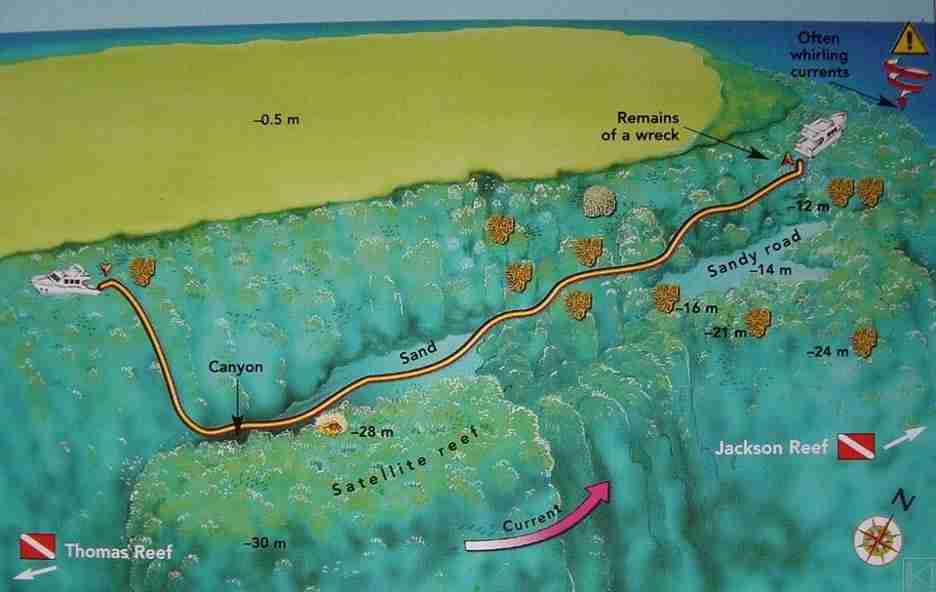
Sitting between Thomas and Jackson at 28°00.119′ N, 34°27.970′ E, Woodhouse is long and narrow. It offers boats no shelter and carries no moorings, so every dive here is a drift, and only in settled weather.
Morning suits it best, because the sun falls directly onto the wall. Along its 0.8 miles the northern half of the eastern side holds the interest: a canyon opens at about thirty metres and runs parallel to the reef until it meets a sandy ledge.
A red anemone marks the canyon exit on the right. Afterwards the ledge widens northwards to fourteen metres and leads towards the saddle joining Woodhouse to Jackson.
What you will see
- Jackfish and turtles through remarkably clear water
- Also sharks, moving along the outside of the wall
- Hard and soft corals in quantity
- Then black coral colonies between 22 and 26 metres
Stop before the saddle: in choppy seas the water turns over there and forms a powerful eddy that local divers call the washing machine. Cross it only in the best conditions.
Thomas Reef, Strait of Tiran
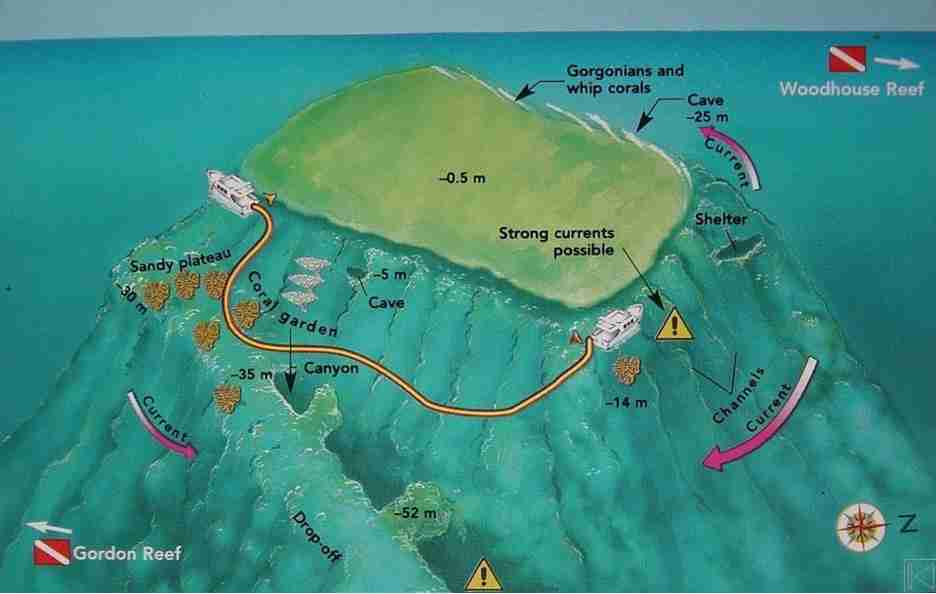
Many divers rate Thomas, at 27°59.437′ N and 34°27.644′ E, as the finest site in the Strait of Tiran and in the northern Red Sea generally. Since there is nowhere to moor, it is dived as a drift, starting from the southern corner.
From there the route runs along the eastern side, where a wall thick with colour descends to a gently sloping sandy plateau beginning around twenty-five metres. Large Dendronephthya, gorgonians and whip corals cover it, along with black coral and the spiral Cirrhipathes.
Beyond a double line of gorgonians, at thirty-five metres, an exceptionally deep canyon opens parallel to the reef, crossed by three arches. That canyon is the reason the site has its reputation.
Going around the reef
A strong counter-current often waits at the eastern corner. If you get past it and conditions hold, the whole reef can be circled.
- Northern wall: shelters and splits in the coral
- Also the western wall, full of crevices and caves
- Then dense fauna along both faces
- Finally whitetip reef sharks, seen on most dives
Level: current, depth and the absence of a mooring make this an advanced dive. Newer divers should take it as a guided drift on the eastern wall only.
Gordon Reef, Strait of Tiran
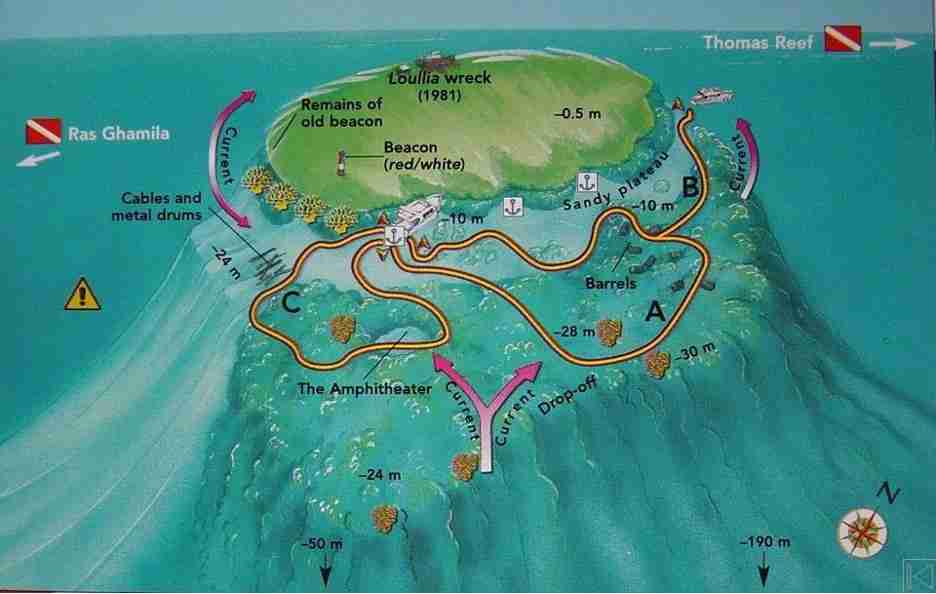
Gordon, at 27°59.097′ N and 34°27.250′ E, is easy to identify: the Panamanian cargo ship Loullia, 3,461 tonnes, has sat aground on its northern end since September 1981. A red and white beacon marks the southwestern corner.
Because a fixed mooring sits on the southern side, and because a wide plateau between ten and twenty-four metres fans out to the southwest, this is the safest of the four sites. Snorkellers do well here too.
Three routes
- Dive A: from the mooring east, then north up the eastern side, past metal drums scattered between 10 and 20 m
- Then dive B: continue north as a drift to a small sandy plateau with garden eels
- Also dive C: explore the vast southern plateau to the circular depression known as the Amphitheatre, or Shark Pool
- Finally return by the reef, or drift the western side through a zone of fire corals
Careful at the beacon: current at the southwestern corner can make the swim back to the boat hard, and sometimes impossible. Plan the exit before you drop in.
Marine life in the Strait of Tiran
Sharks
Whitetip and grey reef sharks year-round, plus scalloped hammerheads from July to September off Jackson.
Pelagics
Barracuda, jackfish and tuna hunt the current line where the plankton enters the channel.
Rays and turtles
Spotted eagle rays cross the plateaus at Gordon, while turtles graze the shallow ground everywhere.
Soft corals
Alcyonarians and gorgonian fans cover the walls, fed constantly by moving water.
Black coral
Colonies of Antipathes sit deep on Woodhouse and Thomas, with spiral Cirrhipathes alongside.
Macro
Nudibranchs such as Chromodoris hide in the madrepore crevices at Gordon.
The island and the wrecks of the Strait of Tiran
Shaped like an orange segment, Tiran covers 3,100 hectares at the entrance to the gulf. Its northern end is low and sandy; the rest rises to Gebel Tiran at 525 metres. Together with Sanafir it forms part of Ras Mohammed National Park.
Mangroves along the southern shore shelter a small dugong population, and eight bird species nest on the island. Ospreys visit regularly.
No landing: Tiran and Sanafir are military zones with an MFO observation post, and landmines remain in places. Diving happens from the boat only.
Wrecks in the strait
- Maria Schroeder, ex Rolf Jarl, aground at Nabq in April 1956
- Also Anghia Vivara, 76 m, aground at Nabq in June 1976
- Hey Daroma, ex Lairds Loch, 90.5 m, aground in September 1970
- Then Million Hope, 174.6 m, aground south of Nabq in June 1996
- Lara at Jackson Reef and Loullia at Gordon Reef
- Finally Niger Basin and Ralai, both lost near Gordon and never found
Planning a day in the Strait of Tiran
Practical notes
- First, dive early: wind builds from the north through the morning
- Also expect drifts at Woodhouse and Thomas, with no mooring available
- Gordon suits newer divers and snorkellers best
- Then carry an SMB on every dive without exception
- Agree the pickup plan before entering the water
- Finally, respect the corner currents: they change the dive completely
Useful links
- The whole coast, north and south — every region covered in one guide.
- The Blue Hole — the sinkhole, the Bells and the Arch.
- Safety standards and emergency care — briefings, oxygen and chamber contacts.
- Red Sea conditions and planning guide — currents, visibility and weighting.
- Red Sea Liveaboard — safari routes and boats across the Egyptian Red Sea.
- Divers Alert Network (DAN) — insurance and emergency guidance.
Frequently asked questions
Which reef is best for a first visit?
Gordon, because of its fixed mooring and its wide shallow plateau. Among the Strait of Tiran sites it is also the kindest to snorkellers.
Why is current so strong here?
The whole Gulf of Aqaba empties and fills through a channel 2.4 miles wide with a sill at seventy-one metres. All that water has to move fast.
When are hammerheads seen?
Mainly between July and September, off Jackson Reef, out in the blue rather than along the wall.
What is the washing machine?
A powerful eddy at the saddle between Woodhouse and Jackson. In rough water it spins hard, so guides end the dive before reaching it.
Can I land on Tiran island?
No. Both islands are military zones, landmines remain in places, and going ashore is not permitted.
Are these sites suitable for snorkelling?
Gordon is, over the shallow plateau near the mooring. Elsewhere the current and the lack of moorings make it unwise.
What are you waiting for?
Book your adventure
Tell us which experience you want to enjoy and leave the rest to us. If you have questions, or you are still choosing between routes, our team will talk it through with you before you commit to anything.
Inquiry