
Dive Techniques · Red Sea Liveaboard Guide
Liveaboard Dive Techniques Entries, exits and staying off the reef
Rules · Entries · SMB · Exits · Buoyancy
The dive techniques on this page exist because you are diving from a boat. A course teaches you to dive; nobody teaches you to roll backwards off a moving tender, to descend before a swell can take you, or to climb a ladder that is dropping half a metre under your feet. Those are the dive techniques the crew explains on the first morning, written down.
The rules that come before any dive techniques
These apply to all recreational diving in Egyptian waters. The guides on board enforce them, and a guide who lets one slide is risking the boat’s licence, not just your safety.
- Spearguns — carrying or using one is prohibited outright
- Gloves — permitted, and they still do not let you touch coral
- Knives — permitted for cutting line and for signalling, nothing else
- Alcohol — never before a dive; a drink after the last dive ends your diving for the day
Depth is set by your training, not by your nerve. Egypt follows WRSTC standards, so your ceiling is 18 m, 30 m or 40 m depending on your certification, and 40 m is the absolute maximum for anyone. Nitrox does not raise it. On nitrox you also hold a maximum oxygen partial pressure of 1.4 bar, which on 32% puts you shallower than 40 m anyway.
Entry dive techniques: getting off the boat
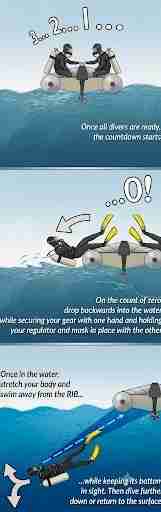
Backward roll: the RIB dive technique
The entry looks trivial and it is where most tender incidents happen. Everyone leaves at the same moment, on a count from the driver, so that nobody lands on a diver who went early. When the tender is full, send every second diver on the count and the rest a beat later.
The name is misleading: you do not roll over. You drop backwards, land flat on your back, and swim clear with a few kicks while keeping the hull in sight. The driver may need the engine at any second to hold the tender off the reef, and he cannot use it with a diver under the stern.
The negative entry technique
In a swell, floating on the surface waiting for the group is the worst place on the dive. The negative entry removes that wait. You go in with an empty BCD, you descend immediately, and the group forms up at about five metres where the surface has stopped mattering.
The buddy check counts double here. A closed valve or a half-full cylinder that you would have caught on the surface becomes an emergency ascent instead, from the one entry that gives you no surface pause to find it.
Giant stride off the dive platform. When the site is under the boat, step off the platform, do not jump — a wet platform and a jump is how people slip. Mask and regulator in one hand, camera and octopus held against you with the other, a look at the water below before you commit, and an OK to the crew as soon as you surface.
SMB dive techniques, step by step
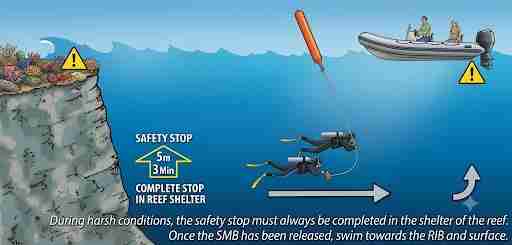
Boat traffic around a mooring is heavy and the drivers are looking for a marker, not for a head. At least one diver in every group sends a buoy up from five metres, every dive.
The buoy is also the thing most likely to take a diver to the surface faster than they intended, which is why the sequence below is worth practising in a pool before it matters on a reef.
The checks you run before you ever get in the water — weighting, reading the current, choosing a site that matches your experience — are on the practical page. This page starts once you are already on a boat.
Sending the buoy up
Exit dive techniques: surfacing and getting back on
The last five minutes
More goes wrong at the end of a dive than at any other point in it. Look up before you ascend and keep looking up, because a hull passing overhead is silent until it is not.
Where to do the safety stop
Hold it beside the reef, not out in the blue. A stop in open water gives the current three minutes to move the whole group away from the boat, and you will not feel it happening.
Surfacing in swell
If a tender is collecting you and the sea is up, move away from the reef before you surface. That way the driver never has to work close to coral with waves pushing him onto it.
Boarding technique: into the tender
Approach from the windward side so wind and swell push the boat away from you rather than over you. Camera or torch up first, then weights, then the unit, then yourself with a couple of hard kicks. Nothing goes up while you are still wearing it.
Ladder technique in swell
Wait clear until the diver above you is on deck. In swell, watch the rhythm and step on as the stern drops, then climb and move out of the way. Fins stay round your wrists rather than being handed up, because you may need them if you come back off.
Never bridge the gap. Boarding a tender from the dive platform, do not stand with one foot on each. Let go of the ladder the moment your foot lands. The tender drifts, and a diver stretched between two moving boats is one of the genuinely dangerous things that happens on a safari.
Dive techniques for particular places
Each of these has a specialty course behind it. What follows is the short version the guides repeat before the relevant briefing, not a substitute for the training.
Wall dive techniques
Watch the gauge, not the wall. There is no bottom to tell you how deep you have drifted. Clip off cameras and torches: anything dropped here is gone.
Drift dive techniques
Enter together, regroup at five metres, stay near the reef. Never swim against it. Sending the buoy up early gives the driver something to follow.
Wrecks
Think hard before going inside. Approved wrecks are inspected, and no wreck was built to sit on a seabed indefinitely.
Cavern dive techniques
A cavern keeps an opening to the surface in sight; a cave does not. Passages branch and narrow. Go with a guide or do not go.
Navigation
Some sites cross featureless sand. Carry a compass, and read the reef shape from the deck before you jump rather than from memory afterwards.
Finding your own boat
Learn the hull, the ladders and the colour of the mooring lines. From underneath, at a busy mooring, boats look far more alike than you expect.
Buoyancy, the technique that decides everything else
Studies of diver contact with coral put the average at roughly one touch every twenty minutes, and photographers well above that. On its own that sounds harmless. Multiply it across fifty boats, twenty guests each and three dives a day for a season, and it stops sounding harmless.
Buoyancy is not a beginner skill you finish with. It is the one technique that decides whether these reefs are still worth diving in ten years, and it also drops your gas consumption and takes the effort out of every dive you make.
With a camera, hold position with your lungs rather than a finger on the reef. A photographer who cannot shoot without touching something is shooting beyond their buoyancy, not beyond their camera.
Useful links
- What is a liveaboard — life on board, the daily schedule and what a week actually looks like.
- The practical page — weighting, reading a current, site choice and the pre-dive checklist.
- The conditions guide — salinity, visibility, temperature, currents, wind and waves.
- Our safari routes — north, the offshore marine parks and the deep south.
- Talk to our team about the route that matches your certification and recent experience.
- WRSTC — the training standards behind Egypt’s depth limits.
- Boats, cabins and departure dates — the wider Egyptian fleet.
- Divers Alert Network (DAN) — dive insurance and emergency procedures.
- HEPCA — mooring systems and reef conservation in the Egyptian Red Sea.
Frequently asked questions
Which dive techniques should I practise before a safari?
Buoyancy first, then sending up an SMB, then a negative entry. Those three cover most of what a boat will ask of you that a course did not.
What is the maximum depth allowed in Egypt?
Forty metres, and your own limit may be shallower depending on your training. Nitrox does not raise it, and the 1.4 bar oxygen ceiling often makes it shallower.
Why is the negative entry used so often here?
Because waiting on the surface in swell is uncomfortable, tiring and the point at which groups get separated. Going straight down keeps everyone together.
Do I always need a surface marker buoy?
At least one per group, on every dive. Traffic around moorings is heavy and a buoy is the only thing a driver can reliably see.
Can I wear gloves in the Red Sea?
Yes. They change nothing about the rule that you do not touch coral or marine life, which is what people usually mean when they ask.
Are these dive techniques taught on board?
Yes. The crew covers them in the first briefing and the guides repeat whichever ones apply before each dive. This page is so you arrive already knowing them.
What are you waiting for?
Book your adventure
Tell us which experience you want to enjoy and leave the rest to us. If you are not sure which route suits your certification and recent experience, our team will talk it through with you before you commit to anything.
Inquiry